Key takeaways
- Start with a dependable everyday core, add route-specific layers, and keep the items needed during a breakdown reachable without unpacking the whole boot.
- Pack against four problems: poor visibility, cold exposure, loss of communication and a longer-than-planned wait.
- Scale the kit to passengers, route and forecast rather than treating every winter drive as an expedition.
- Store safety-critical items where they remain reachable, secure loose equipment and review the kit through the season.
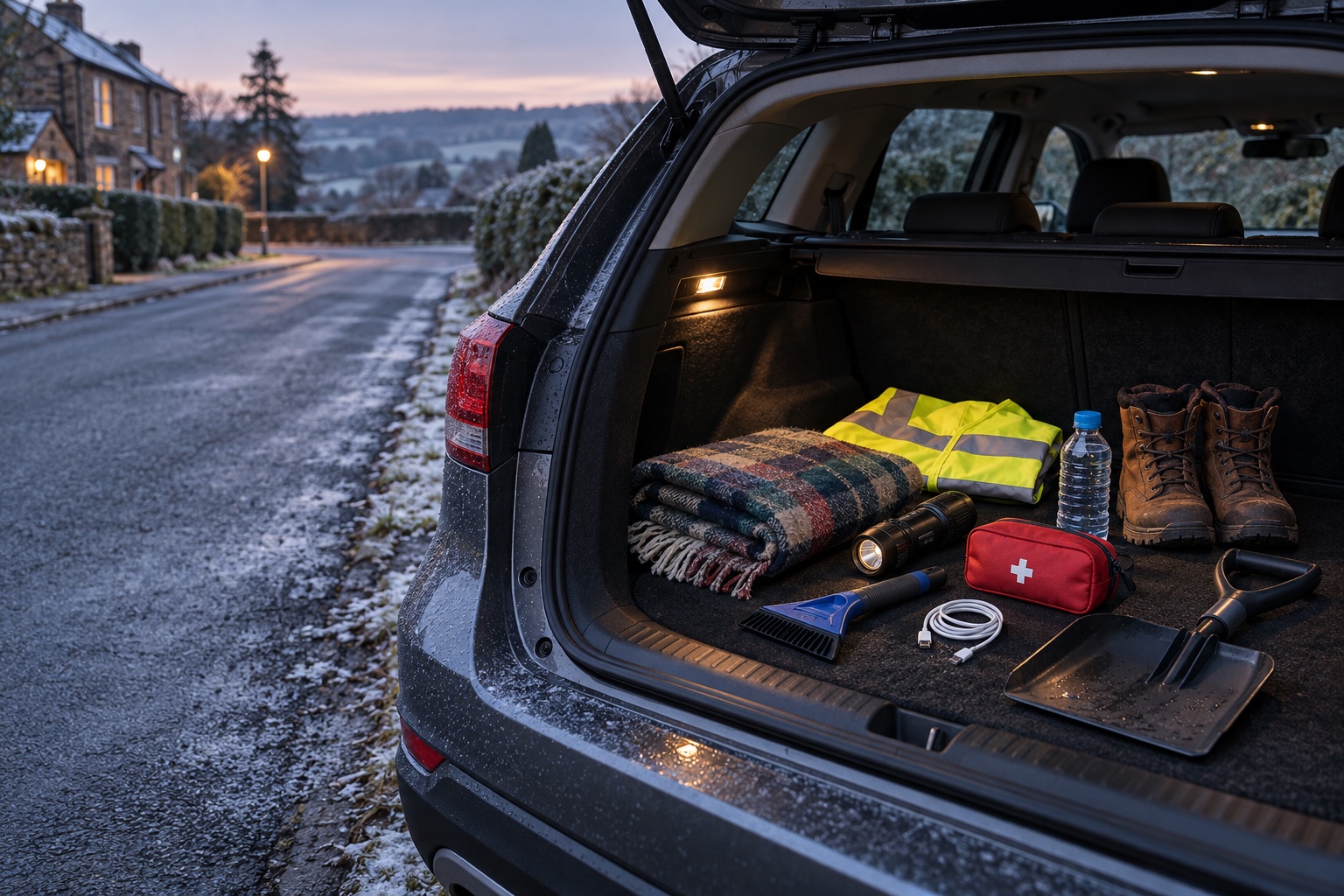
The Highway Code recommends checking the forecast before winter travel and carrying items including de-icer, an ice scraper, torch, warm clothing, boots, a first-aid kit, jump leads, a shovel, a warm drink and emergency food when an essential journey continues in icy or snowy conditions [1]. That list is a starting point, not a reason to buy an oversized bundle. Build three layers: an everyday core for visibility and contact, a long-journey layer for warmth and delay, and a severe-weather layer only when the route and forecast justify it. Keep high-visibility clothing, a charged phone and any essential medication where they can be reached safely, not beneath a loaded boot floor.
Method and limits
This is an editorial decision guide, not a hands-on test of every product shown in Amazon results. Check claims against the exact listing and manual; prices can change.
Key points
- The decision to travel comes before the shopping list: official warnings may justify changing or cancelling the journey.
- A motorway breakdown has different rules from a stop on an ordinary road, particularly around warning triangles and where people should wait.
- A phone charger helps only if the phone, cable, socket and backup power are checked before departure.
- Vehicle checks and breakdown cover are not replaced by a boot full of accessories.
Begin with the journey, not a pre-packed bag
Write down the ordinary winter use case before opening a shopping page. A ten-minute urban commute with frequent services creates a different delay from an evening motorway journey, a rural school run or a trip across exposed high ground. Note the number and age of passengers, any medication or mobility needs, the distance between safe stopping places, the expected temperature and the possibility of rain, ice, fog or snow. Then ask whether the trip is necessary. The Highway Code says to check local forecasts for ice or snow and not to drive in those conditions unless the journey is essential [1]. The Met Office warning system combines likelihood and impact; an amber warning may justify changing plans, while a red warning advises avoiding travel where possible [2]. A kit supports a sensible plan. It does not overrule official advice.
Build an everyday core that stays in the car
The everyday layer should be compact enough to remain in the vehicle and simple enough to inspect. Start with an effective torch, spare or rechargeable power, high-visibility clothing, an ice scraper, appropriate de-icer, a basic first-aid kit, a charging cable that fits the actual phone and a written record of breakdown and insurance contact details. Add a small blanket or warm layer if cold delays are plausible. The government's Be Ready guidance also lists an in-car charger or power bank, food, drink, jump leads and a shovel among items that can form an emergency kit [3]. Do not buy quantity for its own sake. A bright torch you can operate with gloves is more useful than several weak lights, and the correct cable is better than a pouch of obsolete connectors. Test each item before it earns permanent boot space.
Add a long-journey layer for people, not just the car
For a longer route, add enough warmth and simple provisions for everyone travelling. Think in complete passenger sets: coat or insulated layer, hat, gloves, sturdy footwear and a blanket rather than one token foil sheet at the bottom of a family bag. Carry water in a container that can tolerate the expected temperature and food that is sealed, easy to eat and suitable for the people in the car. Include personal medication and any child, older-person or accessibility items that a delay would make urgent. The Met Office winter-kit guidance recommends warm clothes and blankets, food and drink, a charged phone and car charger, boots and a torch among its preparations [4]. Check expiry dates and allergies, and never leave medication in a vehicle if its storage instructions rule out winter temperatures.
Create a severe-weather module rather than hauling it all year
A compact shovel, additional de-icer, extra screen wash, traction aid or more substantial waterproof clothing may make sense for exposed, rural or poorly served routes when severe weather is genuinely forecast. Keep those items together as a removable module. This prevents a city run from carrying unnecessary weight while making the serious kit easy to add when risk rises. National Highways and the Met Office both advise planning the route, checking traffic and weather, and considering whether travel should be delayed when snow or ice is expected [4][5]. Do not assume a shovel can solve a blocked road or that a traction product makes an unsuitable route safe. Snow chains, socks and recovery equipment are vehicle- and condition-specific; check the vehicle handbook, tyre clearances, local rules and instructions before buying or using them.
Keep the first-response items within reach
A beautifully organised boot can fail if the high-visibility vest and phone power are under suitcases when the car stops. Divide storage into a reachable first-response pouch and a larger boot module. The pouch might contain high-visibility clothing, torch, charged power bank, phone cable, contact information and any critical personal item. Secure it so it cannot move into the footwell or become a projectile. Larger blankets, boots, food and a shovel can remain in the boot, but should not be buried beneath a full holiday load. If the safest action is to leave the vehicle, take only what can be reached without standing in danger or returning repeatedly. The Highway Code prioritises moving to a place of relative safety and staying away from moving traffic where possible [6].
Treat visibility as a two-way problem
The kit must help the driver see and help other road users notice people outside the vehicle. Inspect the scraper edge, de-icer instructions, torch beam and reflective areas on high-visibility clothing. Sunglasses can help with low winter sun, but they do not replace a clean windscreen and suitable driving speed. Before setting off, clear snow and ice from every window, clean lights and number plates, demist the glass and remove snow that could fall into another road user's path, as required by the Highway Code [1]. GOV.UK also says drivers are responsible for roadworthiness and should check that windows and mirrors are clean, lights and brakes work, and tyres meet legal requirements [7]. A visibility kit is not compensation for worn wipers, weak washer jets or a failed lamp. Those are vehicle faults to fix.
Understand the warning-triangle exception
A warning triangle can be useful after a breakdown on some ordinary roads, but its presence in a kit does not make it appropriate everywhere. Highway Code Rule 276 says that, where it can be done safely, a triangle should be placed at least 45 metres behind a broken-down vehicle on the same side of the road — but it must never be used on a motorway [6]. On a motorway, the priority is to reach a service area, emergency area or hard shoulder if possible, stop as far left as possible, use hazard lights and get people to a safer place following the detailed rules. If the vehicle cannot reach the left or occupants cannot exit safely, the Code says to remain belted in the vehicle, use hazards and call 999 [6]. Read those rules before a winter trip; roadside is the wrong place to learn them.
Make communication survive a flat battery
Prepare more than one route to help. Fully charge the phone before departure, confirm the in-car socket works, carry the correct cable and test any power bank away from the car. Save breakdown details and key contacts locally rather than relying only on a website. Know where the vehicle's SOS or eCall control is, if fitted, and how to identify location from motorway marker posts or driver location signs. The Highway Code explains that emergency telephones, mapping applications and roadside markers can help communicate a location [6]. A paper note with contact numbers and basic vehicle details is a useful fallback if a phone is locked, damaged or nearly empty. Do not spend scarce battery on entertainment during a long delay, and remember that a power bank also needs seasonal charging and temperature-appropriate storage.
Be selective with jump leads and recovery tools
Jump leads appear in official winter-kit lists, but carrying them and using them safely are different decisions. The exact procedure can vary by vehicle, and modern electronics, hybrids and electric vehicles may have manufacturer-specific restrictions. Read the handbook before buying, confirm cable length and rating, and do not improvise if either battery is damaged, leaking or frozen. A jump pack also needs the correct specification, safe storage and regular charge checks. Tow ropes, tyre inflators and sealant kits carry similar caveats: they are not universal recovery permissions. If the driver is not confident or the location is unsafe, contact professional recovery rather than attempting a roadside repair. The Highway Code specifically says not to attempt repairs after a motorway breakdown [6].
Separate kit readiness from vehicle readiness
Before a longer winter journey, inspect the vehicle itself. GOV.UK lists clean glass and mirrors, working lights and brakes, correct fluid levels, battery checks and legal, correctly inflated tyres among the responsibilities to manage using the vehicle handbook [7]. The Met Office also highlights fuel, wipers, screen wash, lights and tyre condition in its long-journey checks [8]. An emergency bag cannot restore tread, charge a failing starter battery indefinitely or make frozen screen wash flow. Resolve warning lights and defects before departure, know the real fuel or battery range in cold conditions, and identify suitable stops. For an electric vehicle, include charging alternatives and enough margin for temperature, heating and disruption without relying on a universal range penalty that may not fit the exact car.
Secure, date and rehearse the kit
Use a lidded organiser, straps or the car's cargo points so heavy items cannot travel through the cabin under hard braking. Keep liquids upright and away from electronics; follow every product's temperature and storage limits. Label the kit with a review month rather than assuming it will remain ready. At the start of winter and before a long trip, switch on the torch, charge the power bank, inspect cables, check first-aid and food dates, refresh water, confirm clothing still fits and make sure the scraper and shovel have not been removed. Rehearse finding the high-visibility vest and breakdown number in the dark. If another person regularly uses the car, show them the storage layout. Readiness is the ability to reach and use the right item, not merely owning it.
Use a three-level packing card
- Everyday core: torch, high-visibility layer, scraper, de-icer, first-aid kit, correct phone cable, tested power and contact details.
- Long-journey layer: warm clothing and boots for each person, blankets, suitable food and water, medication and route-specific passenger needs.
- Severe-weather module: compact shovel, extra screen wash, waterproofs and only the vehicle-specific recovery equipment you know how to use.
- Before departure: forecast, warnings, traffic, route, safe stops, fuel or charge, tyres, lights, glass, wipers and screen wash.
- Within reach: high-visibility clothing, torch, phone power, contacts and critical personal items.
- Stop rule: postpone the journey when official advice, the vehicle's condition or the driver's readiness makes the plan unsafe.
The Buy Sift verdict
The strongest winter car kit is not the bulkiest bag or the bundle with the longest product list. It is a small, maintained system matched to the people, route and forecast. Keep a tested everyday core in the car, add warmth and provisions for longer journeys, and attach a severe-weather module only when conditions justify it. Place first-response items where they can be reached safely, secure the rest, and learn the motorway breakdown rules before they are needed. Most importantly, treat the kit as the final layer of preparation after the decision to travel, the weather check, route plan and vehicle inspection. Sometimes the most useful item is not in the boot at all: it is the time left in the schedule to delay the journey.
Frequently asked questions
Should a winter car kit stay in the vehicle all year?
Keep a compact everyday core if storage conditions permit, but review batteries, food, water, medication and temperature-sensitive items. Add bulkier severe-weather equipment when the route and forecast justify it.
Can I use a warning triangle after a motorway breakdown?
No. The Highway Code says never to use a warning triangle on a motorway. Follow the motorway breakdown rules for reaching safety, warning traffic and contacting help.
Are jump leads essential for every driver?
They appear in official winter-kit guidance, but safe use depends on the vehicles and the handbook. Carry them only when they are suitable and you understand the procedure; otherwise use professional recovery.
Where should high-visibility clothing be stored?
Where it can be reached safely before stepping near traffic, rather than beneath luggage. Secure it so it does not obstruct controls or move around the cabin.
Does carrying a winter kit mean it is safe to drive in snow?
No. Check official warnings and route conditions first. The Highway Code says not to drive in icy or snowy conditions unless the journey is essential, and a kit cannot make an unsafe journey safe.
Sources and winter-travel notes
- [1] The Highway Code, rules 226–237, Driving in adverse weather conditions, updated 22 October 2025 and accessed 30 October 2026: forecast, essential-journey, winter-kit, visibility and snow/ice guidance.
- [2] Met Office, Weather warnings guide, accessed 30 October 2026: warning colours reflect both likelihood and impact; amber and red warnings can require changed travel plans.
- [3] UK Government Be Ready, Transport disruption and delays, accessed 30 October 2026: journey planning, vehicle checks and example emergency-kit items.
- [4] Met Office, Prepare a winter kit for your car, accessed 30 October 2026: visibility, warmth, phone power, food, drink, boots and other delay preparations.
- [5] National Highways, Travelling in snow and ice, accessed 30 October 2026: route, services, vehicle, forecast, traffic and winter-kit preparation.
- [6] The Highway Code, rules 275–287, Breakdowns and incidents, updated 2025 and accessed 30 October 2026: places of relative safety, high-visibility clothing, warning-triangle restrictions and motorway breakdown procedure.
- [7] GOV.UK, Check your vehicle is safe to drive, accessed 30 October 2026: roadworthiness responsibility and checks for glass, mirrors, lights, brakes, fluids, battery and tyres.
- [8] Met Office, Vehicle checks to make before long journeys, accessed 30 October 2026: fuel, wipers, screen wash, lights and tyre preparation.
- [9] Hero image generated for Buy Sift on 30 October 2026. It depicts a fictional unbranded car and winter kit on a frosty British street and does not imply hands-on testing or reproduce a commercial product.
Build the kit by function
Browse winter car-kit options on Amazon.co.uk
Use search results to compare candidate kits and individual items, then verify contents, dimensions, instructions, seller, storage limits and suitability for your vehicle.
As an Amazon Associate I earn from qualifying purchases. Prices and availability can change before checkout.
Transparency
As an Amazon Associate I earn from qualifying purchases. Some outbound links on Buy Sift point to Amazon.co.uk and use our Amazon Associates tag. If you buy after clicking one of these links, we may earn a commission at no extra cost to you.