Key takeaways
- A strong option for households that regularly dry clothes indoors, provided the machine suits the room and is treated as moisture control rather than a substitute for ventilation or repairs.
- Choose the technology for the temperature of the room, not simply the largest litres-per-day figure.
- Compare real extraction data at ordinary room conditions, airflow, tank access, noise, controls, and drainage before app features.
- Keep ventilation working and report persistent damp, mould, leaks, or building defects rather than trying to solve them with an appliance alone.
Drying washing indoors releases moisture into the home. A dehumidifier can collect part of that moisture and keep air moving around an airer, but it works best inside a deliberate room setup: doors and windows managed sensibly, clothes spaced apart, vents kept clear, and the appliance operated exactly as its manual requires [1].
Method and limits
This is an editorial decision guide, not a hands-on test of every product shown in Amazon results. Check claims against the exact listing and manual; prices can change.
Key points
- Headline extraction capacity is measured under stated conditions and can fall sharply in a cooler, less humid room.
- Air movement across well-spaced laundry is part of the drying system; capacity alone does not describe the experience.
- A tank that is easy to remove may be more useful than continuous drainage when the nearest drain is awkward.
- Laundry mode is a control shortcut, not a guarantee of drying time, energy cost, or performance in every room.
Begin with the moisture problem, not the appliance
There are two separate jobs that are often bundled together. The first is helping a load of washing release moisture in a controlled room. The second is dealing with a home that is already persistently damp. A dehumidifier may help with both, but it should not blur the distinction. GOV.UK guidance explains that washing, cooking, showering, and breathing all add moisture, while inadequate ventilation can trap it and encourage condensation on cold surfaces [1]. If water is entering through a roof, wall, pipe, or failed seal, the buying decision is secondary to identifying the defect. In a rented home, recurring damp or mould should be reported promptly and documented. Government health guidance is explicit that surface cleaning is not a substitute for tackling underlying causes such as defects, inadequate ventilation, or condensation [2]. Buy a dehumidifier to support a sound moisture plan, not to make an unresolved housing problem easier to ignore.
Map the drying room before comparing litres
Write down where the airer actually stands, the approximate room size, the lowest temperature you expect, and whether a door can be kept closed without blocking essential ventilation. Check the route to a socket and make sure the cable will not cross a wet or busy walkway. Then measure the space for the machine with its tank, filter, handle, louvre, and drainage connection all accessible. A product width is not the operating footprint: the inlet and outlet need clearance, the tank must slide out, and laundry must not drape over the unit. If the only possible location is wedged between a wall and the airer, the room is telling you that a smaller airer, a different drying schedule, or another drying method may be the better first change.
Read extraction figures in their test conditions
The large capacity number usually describes the maximum amount of water a unit can remove in a day under specified temperature and relative-humidity conditions. It is not a promise that a nominal 12-litre machine will collect 12 litres from your spare room every day. Manufacturer tables show why context matters: the same compressor model can remove materially less water at 10°C and 60% relative humidity than at 30°C and 80% [3]. Look for a table rather than a single headline. Compare performance at a temperature and humidity closer to your home, then check the associated wattage and airflow. This also prevents a common mistake: assuming that a larger label automatically means faster laundry drying. The larger unit may move more air and extract more water, but its size, noise, tank, and controls still need to work in the room where you will use it.
Compressor or desiccant: let temperature lead
A compressor dehumidifier cools part of the air path so water condenses, then returns drier air to the room. It is often the natural shortlist for a normally heated bedroom, living room, or utility space. A desiccant model passes air through a moisture-absorbing material and can remain useful in colder spaces where a compressor unit's extraction falls. The trade-off is not a simple winner-and-loser table. Desiccant machines commonly use more power at their stronger settings and can warm the outlet air; compressor models are usually heavier and their performance varies more with temperature. Manufacturer guidance commonly uses room temperature as the first branch in the decision [4]. Treat any precise threshold as model guidance, not a universal law: inspect the operating range, extraction table, wattage, and manual for the exact machine. For a heated flat, compare compressor options first. For a genuinely cold utility room, garage, or conservatory, include desiccant models rather than buying on litre capacity alone.
Laundry mode is useful, but airflow does the visible work
On many products, laundry mode simply runs the fan and dehumidification more assertively for a fixed or adjustable period. That can be convenient, but the label does not standardise a drying result. A tightly packed airer will still dry unevenly because air cannot reach the hidden fabric. Start with a good final spin where the garment care label allows it, shake items out, leave gaps, and expose thicker seams and waistbands. Position the airer and machine according to the appliance manual, directing adjustable airflow towards the laundry only where the manufacturer permits. Close the room door if that is part of the recommended setup, but do not block trickle vents, extractor systems, or required background ventilation. Energy Saving Trust notes that dehumidifiers can help remove excess moisture and assist with indoor washing, while its ventilation advice still treats fresh-air exchange as a separate part of controlling condensation [5].
Noise has two meanings: loudness and character
A decibel figure is useful only when the test distance and operating mode are clear. Laundry mode may use a higher fan speed than the quiet figure highlighted near the top of a listing. Beyond volume, listen for the type of sound described in recent reviews: steady fan noise is easier for many people to ignore than cycling, rattling panels, a sharp compressor start, or repeated alert tones. The room changes the result. Hard floors and bare walls reflect noise; a hollow landing can carry it into bedrooms; a utility room behind a closed door may make the same machine unobtrusive. If the unit will run during calls or sleep, prioritise a controllable low mode, dimmable display, and alerts that can be silenced. If it will run only beside laundry in daytime, stronger airflow may matter more than the quietest specification.
Decide how the water will leave the machine
For occasional laundry cycles, a removable tank is simple and visible. Check its capacity, handle, lid, fill indicator, and whether it can cross the room without sloshing. Confirm that the appliance stops safely when the tank is full; otherwise a small tank can interrupt a long cycle before thick items are dry. Continuous drainage sounds maintenance-free, but gravity still matters. Many standard hoses can only run downwards without a separate pump, and the correct diameter or adaptor may not be included. A hose stretched across a doorway creates a worse problem than emptying a tank. Also check filter access: a washable pre-filter that slides out without moving the appliance is easier to maintain, and restricted airflow can reduce useful performance. Put these ordinary details above Wi-Fi control. You will handle the tank and filter far more often than you will admire the app.
Compare running effort, not a made-up monthly saving
An honest cost comparison needs the machine's power draw in the mode you will use, your electricity tariff, and the number of hours it actually runs. Multiply watts by hours, divide by 1,000 to get kilowatt-hours, then multiply by your current unit rate. Do not use a retailer's pence-per-hour claim without checking the tariff and test condition behind it. A humidistat that pauses extraction after reaching its target can reduce unnecessary runtime, but control logic differs between models and the fan may continue periodically to sample the air. A timer is helpful for a known laundry session; auto-restart may matter after brief power interruptions; neither proves low consumption. We do not publish a universal saving because load size, room temperature, starting humidity, airflow, tariff, and machine behaviour all change the answer. Compare your likely cycle, not an idealised laboratory day.
Run a seven-point listing and manual check
- Find the full extraction table and compare a realistic temperature and humidity, not only the maximum headline.
- Check the operating-temperature range and whether the design is compressor or desiccant.
- Compare airflow and noise in laundry or high-fan mode, including the stated measurement distance.
- Measure the full operating footprint and leave the inlet, outlet, tank, filter, and louvre accessible.
- Confirm tank capacity, full-tank shut-off, drainage-hose requirements, and whether a pump is needed for upward drainage.
- Read the manual's placement, clearance, transport, cleaning, and refrigerant safety instructions before choosing a permanent spot.
- Check the current seller, warranty route, delivery, returns, and availability of replacement filters or other consumables.
Know when not to solve the problem by shopping
Do not treat a new appliance as the next step when there is an active leak, wet plaster, recurring mould, a broken extractor, a blocked vent, or a room that cannot be safely heated or ventilated. Persistent damp deserves investigation, and tenants should contact the landlord or managing agent rather than accepting blame for a building defect. A dehumidifier also may not be the right answer for a household that dries one small load occasionally and can already use effective ventilation. In that case, better spacing, an extra spin, and a well-placed ordinary airer may be enough. At the other extreme, a large family producing frequent loads may find that a heat-pump tumble dryer or a dedicated utility-space plan provides a more predictable routine. The best purchase is not the machine with the most modes; it is the solution that controls moisture without turning a shared room into a permanent laundry plant.
The Buy Sift verdict
A dehumidifier is a persuasive autumn and winter purchase when laundry regularly dries indoors and the home already has a sensible ventilation and maintenance plan. Choose by room temperature first, then realistic extraction data, airflow, operating noise, tank or hose routine, and the physical route around the airer. The shortlist should shrink when you read the manual, not expand when you see another smart feature. For a warm lived-in room, a well-sized compressor model is often the practical starting point. For a colder unheated space, a desiccant design deserves comparison. In either case, give the machine open airflow, give the clothes space, and give persistent damp the proper investigation it needs.
Frequently asked questions
What size dehumidifier is best for drying clothes indoors?
There is no single litre rating that suits every home. Start with room temperature, room size, load frequency, and the maker's extraction data at realistic conditions. A higher-capacity model may help with frequent or heavy loads, but only if its airflow, noise, footprint, and tank routine suit the space.
Should I close the window when using a dehumidifier for laundry?
Follow the appliance and home-ventilation guidance for your setup. A dehumidifier generally works on the air within a defined space, but it must not be used as a reason to block required trickle vents, extractor systems, or background ventilation. If condensation persists, review the wider moisture and ventilation problem.
Is a desiccant dehumidifier better for a cold room?
Desiccant designs can remain effective in colder rooms where compressor performance may reduce, but they can have different power use and heat output. Compare the exact operating range, extraction table, wattage, noise, and manual rather than relying on the technology name alone.
Can a dehumidifier replace a tumble dryer?
It can support air-drying by removing moisture from the room and increasing airflow, but it does not tumble garments or guarantee a fixed finish time. Compare space, fabric care, load volume, energy use, ventilation, and the amount of handling each routine requires.
Will a dehumidifier fix mould?
It may help reduce excess airborne moisture, but it will not repair a leak, structural defect, inadequate ventilation, or established mould problem. Persistent damp or mould should be reported and the underlying cause addressed promptly.
Sources and practical notes
- [1] UK Government, Existing home ventilation guide, updated 24 March 2026: household washing adds indoor moisture, while effective ventilation removes stale air and moisture.
- [2] UK Government, Understanding and addressing the health risks of damp and mould in the home, updated 1 April 2026: underlying causes must be identified and addressed; surface treatment alone is not enough.
- [3] Meaco published extraction tables for current UK compressor dehumidifiers show substantially different water removal at different temperature and relative-humidity test points. The tables are used here only to explain how to read specifications, not as a product endorsement.
- [4] Meaco's compressor-versus-desiccant guidance describes room temperature as a major selection factor. Always defer to the operating range and manual for the exact model.
- [5] Energy Saving Trust, ventilation and damp guidance: dehumidifiers can help remove excess moisture and support indoor laundry drying, but ventilation remains important.
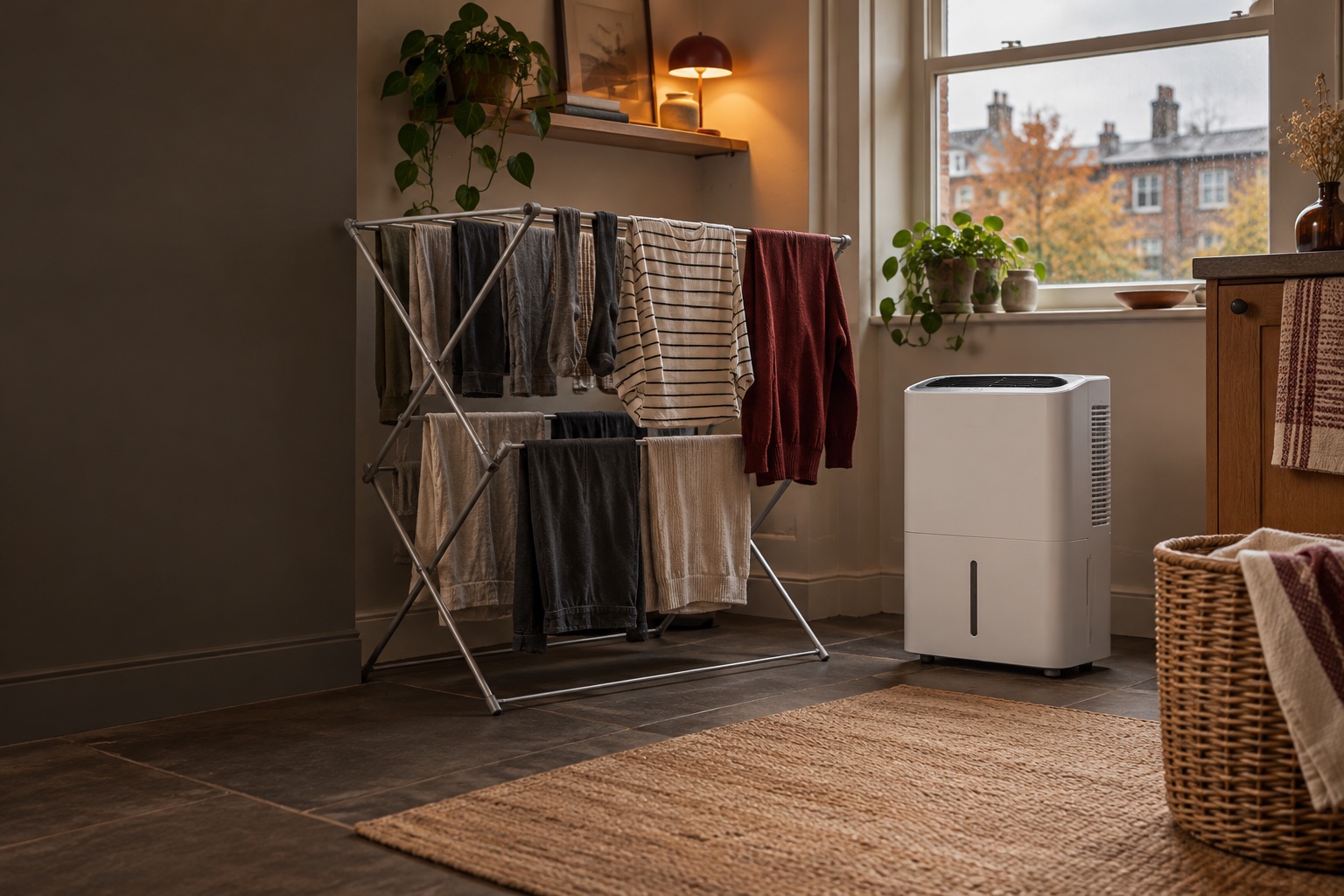
- [6] Hero image generated for Buy Sift on 12 October 2026. It depicts a fictional, unbranded appliance and does not imply hands-on testing or a recommendation of a specific model.
Indoor laundry shortlist
Compare dehumidifiers with laundry mode on Amazon.co.uk
Use the listing to find candidates, then verify realistic extraction data, room-temperature range, noise, drainage, clearance, warranty, and the full manual before buying.
As an Amazon Associate I earn from qualifying purchases. Prices and availability can change before checkout.
Transparency
As an Amazon Associate I earn from qualifying purchases. Some outbound links on Buy Sift point to Amazon.co.uk and use our Amazon Associates tag. If you buy after clicking one of these links, we may earn a commission at no extra cost to you.