Key takeaways
- For a small home, practical fit is the product: route, operating clearance, storage, noise and upkeep should outrank category position.
- Map the delivery route and measure the full operating envelope, not only the listed body dimensions.
- Score storage, noise, cable route, cleaning and replacement parts alongside capacity and headline features.
- Reject products that require permanent counter space or maintenance the household will not realistically provide.
Amazon Best Sellers can surface familiar home-product formats, but a ranking cannot see your doorway, worktop, shared wall or cupboard. Give each candidate a room-fit score before comparing features. The best choice may be smaller, quieter, foldable, easier to clean or simply unnecessary — even when a larger model appears more popular [1].
Method and limits
This is an editorial decision guide, not a hands-on test of every product shown in Amazon results. Check claims against the exact listing and manual; prices can change.
Key points
- Compact on a listing can still mean awkward when a lid, handle, hose or door is open.
- Capacity should match household throughput, not the largest number that fits the budget.
- Noise and light can turn a popular device into conflict in shared or open-plan rooms.
- A folding or multi-use product only saves space if converting and storing it is genuinely easy.
Draw the route before choosing the room
Measure the narrowest doorway, turn, stair, lift and gap the parcel must pass through. Then consider whether delivery packaging is larger than the assembled product and where that packaging can be opened. This matters for furniture, air-treatment appliances and bulky storage, but the habit also catches smaller problems such as a wide handle that will not clear a cupboard frame. In rented flats, note shared corridors and rules about leaving parcels or packaging. Do not assume an item can be unpacked outside and carried in safely. If the route is close, look for the packed dimensions or assembly instructions. A product that fits the final corner but cannot reach it is not a small-space solution.
Measure the operating envelope
Listed dimensions usually describe the closed body. Add the space needed to open the lid or door, remove a tank, slide out a basket, connect a hose, turn a handle, load ingredients, ventilate a motor or reach the controls. Mark that envelope with tape or a cardboard footprint in the real room. Check overhead shelves and nearby heat-sensitive surfaces. A compact air fryer that must be pulled forward for ventilation may occupy more worktop during use than expected; a vacuum dock may need clear vertical space. Use the exact manual where possible because clearance can be a safety requirement, not a preference. If the product only works after another daily-use item is moved, count that friction in the score.
Give storage a retrieval test
Choose the actual storage location and rehearse the movement: lift, unfold, carry, connect, use, cool, clean and put away. A product stored above shoulder height may be impractical when heavy or hot. One kept under a bed may collect dust or be blocked by other boxes. Count detachable parts and where they live; a compact base with three loose accessories can create more clutter than one larger integrated tool. Folding mechanisms earn points only when they are quick and robust enough for regular use. If the product is likely to remain out because storage is awkward, judge it as a permanent visual and physical occupant. The most space-efficient object is often the one the household can retrieve and return without negotiation.
Match capacity to throughput
Larger capacity is useful only when the household regularly processes that amount. Write the common load: two portions, one room, one laundry basket, a week's paperwork or a weekend trip. Then check whether the product can handle that load without wasteful half-empty cycles or awkward repeats. A small appliance may need two batches; a large one may take too much worktop and cleaning for everyday use. Compare usable internal dimensions where shape matters, not just litres. For bins, tanks and storage, ask how heavy the full container becomes and whether the route to empty it is easy. Popularity can favour broadly useful middle sizes, but your routine should decide the capacity.
Score noise, light and shared-wall behaviour
Small homes put motors, alerts and indicator lights closer to people. Identify when and where the product will run: during calls, after children sleep, beside a neighbour's wall or in an open-plan kitchen. Published decibel figures can help only when test conditions are comparable; the character of a motor, clicks and alarms also matters. Search recent reviews for specific descriptions, then verify adjustable alerts, night modes or display controls in the manual. Do not promise that a product is quiet based on a category badge. Give extra weight to manual controls and a straightforward off state. A device that needs to run unattended overnight deserves a separate safety and placement check under its instructions.
Trace the cable, socket and charging route
Mark the nearest suitable socket and check cable length without planning to stretch it across a walkway. Avoid treating an extension lead as the default solution, especially for high-power appliances; follow the manufacturer's electrical guidance. For rechargeable products, decide whether they need a permanent dock, a shelf near power or regular movement to a charger. A wall-mounted dock may require landlord permission and a suitable fixing surface. Connected devices also need reliable network coverage in the exact location. Photographing the corner can help reveal conflicts with doors, radiators and cleaning paths, but keep personal information out of shared images. A clean cable route is part of fit, accessibility and daily safety.
Run the cleaning simulation
Read which parts detach, whether they are dishwasher-safe under the exact instructions, how tanks empty and where filters dry. Imagine doing the routine at the smallest sink in the home. Large baskets, reservoirs and trays may not fit or may splash the surrounding area. Check whether the product needs to cool before storage and whether wet parts require overnight space. Search for seams, textured surfaces or narrow passages mentioned in specific reviews, while remembering that reviews are prompts rather than verified universal findings. If a product saves ten minutes in use but creates a twenty-minute cleaning and drying job, its small-home benefit may be illusory. Give simple, accessible maintenance a high score.
Price the ownership cupboard
List filters, bags, brushes, refills, attachments, batteries and special cleaners. Estimate their physical storage as well as their cost. A year's supply of proprietary refills can occupy more room than the device, while an uncommon accessory may be difficult to replace. Check exact part numbers and current UK availability without assuming today's stock will continue. Avoid precise lifetime-cost claims unless usage and prices are verified. Instead, compare systems: standard consumable versus proprietary, washable versus replaceable, integrated tool versus several loose heads. A popular product can be commercially successful because of an ecosystem that is inconvenient for your cupboard. The ownership score should include every item the routine brings into the home.
Check offer, delivery and return logistics
Confirm the exact model, size, colour, condition, seller and dispatcher. Amazon explains that Marketplace offers may have different fulfilment and customer-service arrangements [2]. Check delivery to the actual address, including access instructions you can provide safely. Read the return terms before ordering, especially for bulky, assembled, hygiene-sensitive or used products. Amazon's general policy includes item-specific conditions [3], and UK online-shopping rights have exceptions alongside protections for faulty goods [4]. Consider whether you could re-pack and move the item if it fails the room-fit test. A difficult return does not automatically rule out a purchase, but it should raise the confidence required before a large parcel enters a small home.
Use the ten-point room-fit scorecard
- 2 points: route and packed dimensions are comfortably clear.
- 2 points: operating envelope fits without moving another daily-use object.
- 2 points: storage and retrieval are easy for the intended user.
- 1 point: capacity matches the ordinary household load.
- 1 point: noise, light and controls suit the room and schedule.
- 1 point: cleaning works at the available sink and drying space.
- 1 point: cables, consumables, parts and return logistics are acceptable.
Interpret the score without pretending it is science
The scorecard is a comparison tool, not a laboratory rating. A nine-point product can still fail if the missing point is a safety clearance or accessibility need. Use the total only after every non-negotiable passes. Compare two or three candidates and write the reason behind each lost point. That explanation is more valuable than the number because it reveals whether a trade-off can be managed. A foldable model might lose capacity but gain storage; a larger appliance might earn its footprint by replacing two existing objects. Also score the no-buy option. Reorganising a cupboard, repairing the current product or borrowing an occasional-use tool can beat every candidate.
The Buy Sift verdict
Amazon Best Sellers is useful for seeing which home-product formats attract attention, but compact living turns ordinary trade-offs into daily consequences. Map the route, operating envelope and storage movement before comparing features. Match capacity to throughput, inspect noise and cable routes, rehearse cleaning and count the ownership cupboard. Then verify the exact offer and exit route. The winning product is not necessarily the smallest or highest ranked. It is the one that earns its volume through regular use and can be operated, cleaned and put away without reshuffling the room. If no candidate clears that test, keeping the space is a valid result.
Frequently asked questions
Are listed product dimensions enough for a small flat?
Usually not. Add packed route, open doors or lids, removable tanks, ventilation clearance, cable bends and the space needed to clean or load the item.
Should I always choose the smallest capacity?
No. Choose the smallest capacity that handles the ordinary load without inefficient repeats, then check whether its operating and cleaning routine fits.
How can I judge noise before buying?
Use comparable published specifications, the manual's modes and several specific recent reviews. Consider alerts, vibration and indicator lights as well as motor volume.
Do foldable products always save space?
Only when folding is easy, the folded shape fits a real location and loose parts do not create separate clutter. Rehearse retrieval and storage before ordering.
What score should a product achieve?
Use the score to compare candidates, not as an automatic pass. Every safety, access and hard-fit requirement must pass regardless of the total.
Sources and small-space notes
- [1] Amazon.co.uk Best Sellers is a changing category discovery page. Rank is not a Buy Sift quality score or evidence of suitability for a particular home.
- [2] Amazon UK Help, Ordering from a Marketplace Seller: Sold by and Dispatches from identify different offer and fulfilment arrangements.
- [3] Amazon UK Help, About Our Returns Policies: product categories and conditions can have different return requirements.
- [4] GOV.UK, Online and distance selling and Accepting returns and giving refunds: many online purchases carry cancellation rights with exceptions, alongside rights for faulty goods.
- [5] Competition and Markets Authority, Fake reviews guidance, 2025: rankings and review information should not be treated as substitutes for checking the exact product and evidence.
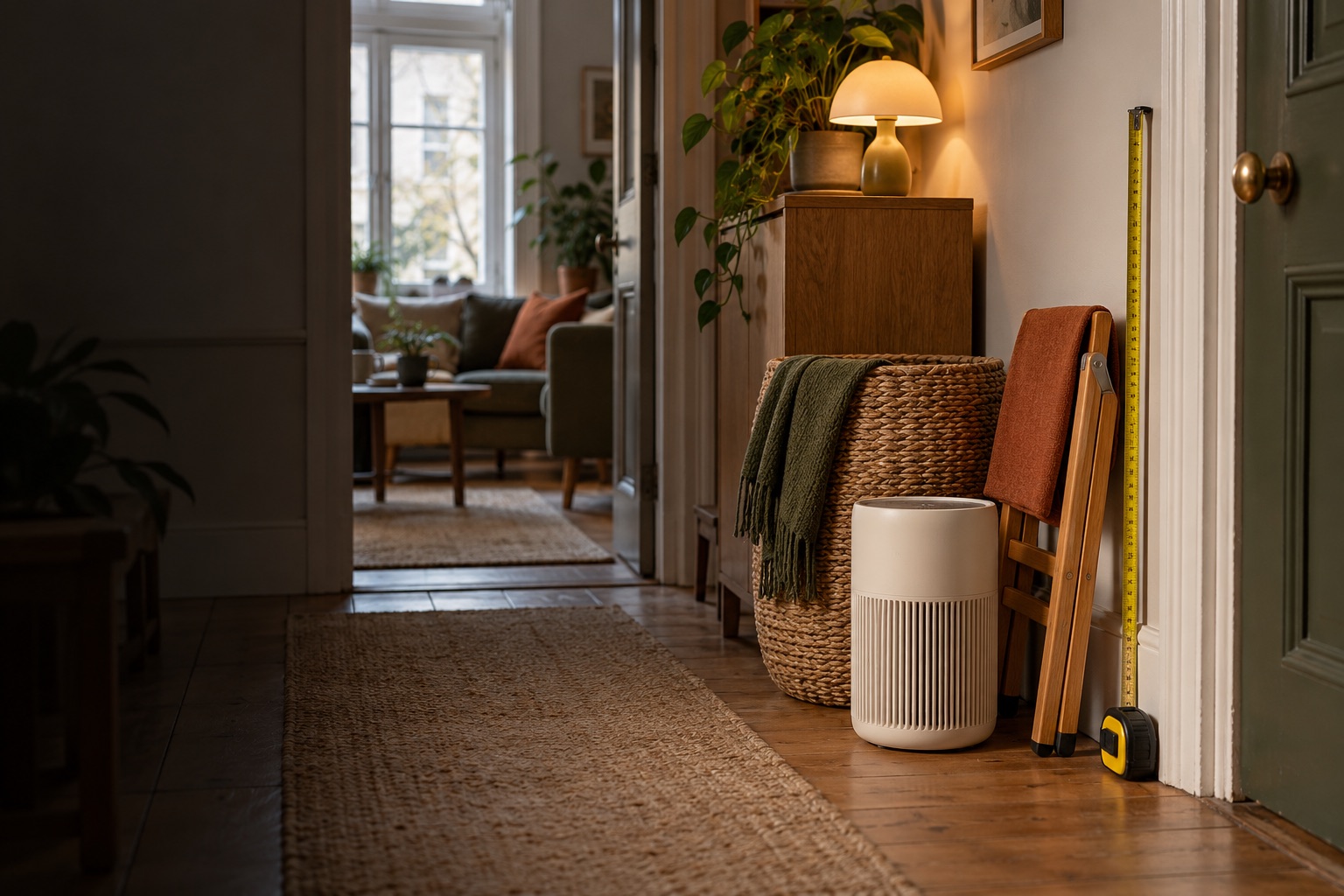
- [6] Hero image generated for Buy Sift on 15 October 2026. It shows fictional, unbranded household products and does not reproduce Amazon content or imply testing.
Small-home discovery
Browse Amazon UK Best Sellers with the room-fit scorecard
Use popularity to find candidates, then measure route, operating space, storage, noise, cleaning, seller and returns for the exact product.
As an Amazon Associate I earn from qualifying purchases. Prices and availability can change before checkout.
Transparency
As an Amazon Associate I earn from qualifying purchases. Some outbound links on Buy Sift point to Amazon.co.uk and use our Amazon Associates tag. If you buy after clicking one of these links, we may earn a commission at no extra cost to you.